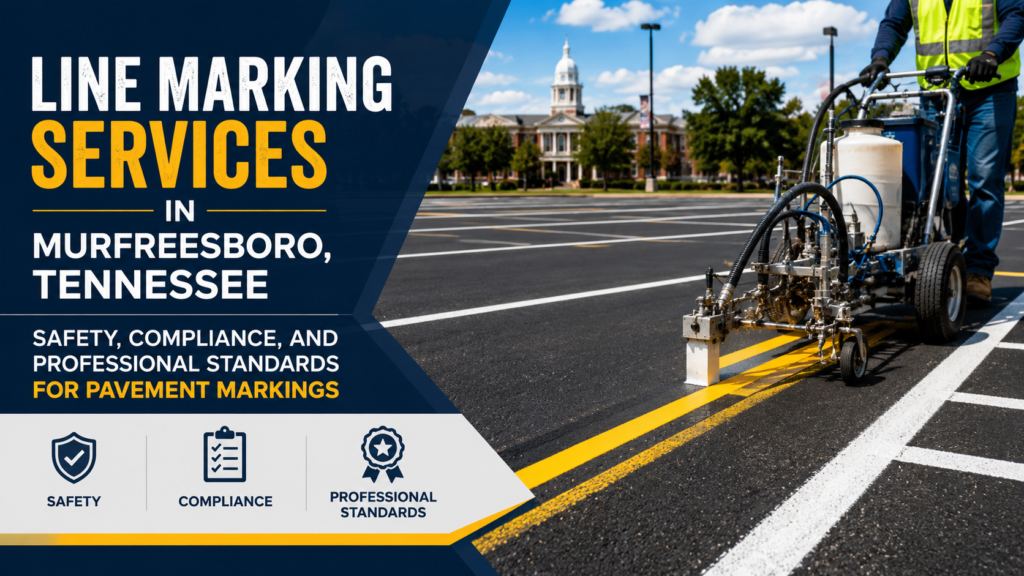
Parking lot line marking also called striping, pavement marking, or line painting is one of those services that tends to be invisible when done well and painfully obvious when neglected. A well-marked parking lot in Murfreesboro directs drivers efficiently, keeps pedestrians safe, ensures ADA compliance, meets fire code requirements, and presents a professional, well-maintained face to every customer and visitor who arrives at a commercial property. Faded, missing, or incorrectly applied line markings, on the other hand, create confusion, legal liability, and the kind of first impression that no business in Murfreesboro’s competitive commercial environment wants to make. Understanding what professional Line Marking Sevice Murfreesboro involve, when they are needed, and what standards they must meet helps property owners and managers take the right approach to this essential pavement maintenance service.
What Line Marking Services Cover
Professional line marking in Murfreesboro encompasses far more than simply painting straight white lines for parking spaces. A complete line marking program covers:
- Standard parking stall lines: The white or yellow lines defining individual parking spaces, applied at correct angles (90-degree, 60-degree, or 45-degree configurations) and dimensions (typically 9 to 10 feet wide by 18 to 20 feet deep for standard stalls in Tennessee commercial applications).
- ADA accessible parking spaces and access aisles: The blue-and-white accessible space markings, the diagonal-lined access aisles adjacent to accessible spaces, and the required International Symbol of Accessibility (wheelchair symbol) painted on the pavement surface.
- Fire lane markings: Red-painted curbs and “FIRE LANE – NO PARKING” text stenciling required by Murfreesboro Fire Department codes in commercial parking areas.
- Traffic flow arrows: Directional arrows guiding one-way or specific-direction traffic through parking areas and access drives.
- Crosswalks: Pedestrian crossing markings connecting accessible parking areas, building entrances, and pedestrian routes across vehicle traffic lanes.
- Stop bars and yield markings: Control markings at entrances, exits, and internal intersections within larger parking facilities.
- Loading zone and no-parking designations: Yellow curb markings and text designating restricted areas for commercial loading, emergency access, or other restricted uses.
- Speed limit and other informational markings: Pavement stenciling of speed limits, parking space numbers, and directional text where required by the site layout.
Why Line Markings Fade and When Restriping Is Needed
Line markings on asphalt parking lots in Murfreesboro fade over time from several forces working simultaneously:
- UV exposure: Middle Tennessee’s summer sun bleaches traffic-grade paint, causing the pigment to fade. White lines turn gray; yellow lines lighten significantly.
- Traffic wear: Vehicles driving over line markings particularly at lot entry/exit points and at the front of parking stalls where vehicles approach and overhang gradually wear away the paint film.
- Sealcoating: When sealcoat is applied to maintain the asphalt surface, it covers the existing line markings. Restriping is always required after sealcoating and should be scheduled as part of the sealcoating project rather than as a separate follow-up.
- Plowing and cleaning: Snow plowing and pressure washing accelerate paint wear, particularly for markings that are not applied to adequate film thickness.
Most parking lot striping professionals in Middle Tennessee recommend restriping every two to four years under normal traffic conditions, with higher-traffic commercial lots potentially needing restriping more frequently. A lot that’s been sealcoated and restriped on a consistent schedule maintains clarity and compliance far more effectively than one that’s restriped reactively when markings become illegible.
ADA Compliance: The Legal Dimension of Line Marking
For Murfreesboro commercial property owners, ADA compliance is the most consequential aspect of parking lot line marking from a legal perspective. The Americans with Disabilities Act (ADA) establishes specific, enforceable requirements for accessible parking that apply to any property open to the public. Key ADA requirements that affect line marking include:
- Required number of accessible spaces: ADA mandates a minimum number of accessible spaces based on total lot size. A lot with 1 to 25 spaces requires 1 accessible space; a lot with 26 to 50 requires 2; and the requirement scales upward with lot size. At least one in every six accessible spaces must be van-accessible.
- Dimensions: Standard accessible spaces must be at least 8 feet wide. Van-accessible spaces must be 8 feet wide with an adjacent 8-foot access aisle (or 11 feet wide with a 5-foot aisle).
- Access aisles: Access aisles must be marked with diagonal hatch lines to prevent parking. They must be level (maximum 2 percent slope in any direction) and located on the correct side of the accessible space to allow wheelchair access to the vehicle door.
- Slope compliance: The accessible space and its access aisle must not exceed 2 percent slope in any direction. Spaces on sloped parking lot sections are a common compliance failure.
- Signage: The International Symbol of Accessibility must appear on a vertical sign (not just on the pavement) mounted at the correct height. Pavement markings alone are insufficient for ADA compliance.
Non-compliance with ADA parking requirements exposes property owners to civil complaints, enforcement actions, and significant financial penalties. The U.S. Department of Justice has authority to pursue penalties of up to $75,000 for first violations and $150,000 for subsequent violations. Professional line marking companies in Murfreesboro with ADA expertise review accessible space compliance as part of their marking service.
The Line Marking Application Process
Professional line marking in Murfreesboro follows a structured process that distinguishes quality results from quick-and-cheap applications:
- Layout planning: For new striping layouts or reconfigured lots, the contractor plans the space layout to maximize stall count while maintaining required drive aisle widths (typically 20 to 24 feet for two-way flow), ADA-compliant accessible spaces, and fire lane clearances.
- Surface preparation: The asphalt surface must be clean and dry before paint application. Professional stripers blow or sweep the surface clean of loose debris, sand, and dust. Pressure washing may be used when significant contamination is present, with adequate drying time before application.
- Layout marking: Chalk lines or tape guide marks are laid out to ensure straight, correctly positioned lines before paint is applied.
- Paint application: Traffic-grade striping paint is applied using professional striping machines that maintain consistent line width (typically 4 to 6 inches for standard stall lines) and film thickness. Proper film thickness is critical for durability thin applications fade quickly.
- Stenciling: Symbols, text, and wheelchair symbols are applied using professional stencils to achieve consistent, accurate results.
- Drying time: Most traffic-grade paints are dry to vehicle traffic within 30 to 60 minutes under normal conditions. Hot, dry summer days in Murfreesboro accelerate drying; humid days slow it.
First Impressions and the Business Case for Fresh Markings
Beyond safety and legal compliance, fresh, clearly visible parking lot line markings communicate something important to every customer who arrives at a Murfreesboro business: that this property is professionally managed and that the business behind it pays attention to quality and detail. Research consistently shows that parking lot appearance affects customer decisions about patronizing businesses. Faded lines, missing accessible space markings, and confusing traffic flow all contribute to a negative first impression that undercuts marketing and customer service efforts made inside the building.
In Murfreesboro’s competitive commercial landscape where the city’s growth has brought national retail and restaurant chains to compete with established local businesses the external presentation of commercial properties has never mattered more. Fresh pavement markings are one of the least expensive, highest-visibility improvements a commercial property owner can make.
Conclusion
Line marking services in Murfreesboro are a professional pavement maintenance service with safety, legal compliance, and business presentation dimensions that make them essential to any commercial property management program. Understanding what comprehensive line marking covers, when restriping is needed, what ADA requires, and how professional application differs from amateur effort equips Murfreesboro property owners and managers to take the right approach to this visible but often underestimated aspect of property maintenance.